
Foreign buyers can hold full title
Spain places no general restriction on foreign nationals buying property. You hold full legal title to the home, and it can be registered in your name at the Land Registry.
A plain-language guide to buying in Spain, drawn mainly from official sources. The purchase step by step, taxes by region, residency, healthcare, schools and climate, and what changes depending on the country you are buying from.
Four things to know before anything else.
Spain places no general restriction on foreign nationals buying property. You hold full legal title to the home, and it can be registered in your name at the Land Registry.
The deed of sale is signed before a notary, a public official who is impartial between buyer and seller. The notary checks identities, the seller’s title, charges on the property and how the price is paid.
Since 3 April 2025, Spain no longer grants residence permits for property investment. Whether you can live in Spain depends on your nationality, covered below.
Transfer tax on a resale home is set by each of Spain’s autonomous regions: 6% in Madrid, 7% in Andalusia and 10% or more in Catalonia, for example. Know the rate where you are buying before you make an offer.

At AEMET’s stations at Málaga, Almería and Alicante-Elche airports and in Murcia, long-term averages show more than 2,900 hours of sunshine a year and daily highs close to 17°C in January. The Canary Islands are warmer still in winter, and the north coast is cooler and much wetter.
677 beaches flew the Blue Flag in 2026, and 50 places are on UNESCO’s World Heritage List, from the Alhambra to the works of Gaudí.
The Mediterranean diet is on UNESCO’s list of intangible cultural heritage, and the 2026 Michelin Guide lists 306 starred restaurants in Spain.
Madrid, Barcelona, Palma and Málaga airports each handled more than 25 million passengers in 2025, and high-speed trains link Madrid with Barcelona, Valencia, Alicante, Málaga and Seville.
Sources: AEMET climate normals 1981 to 2010 (Murcia 1984 to 2010); ADEAC, Blue Flag 2026; UNESCO; Michelin Guide Spain 2026; Aena, 2025 passengers (provisional).
Prices, taxes, climate and how you get there change a great deal from one coast to the next. Choose an area to compare.
Hours of sunshine a year, with the average daily high in January and in August.
Sources. Prices and market activity: Colegio de Registradores (Spain’s land registrars), Estadística Registral Inmobiliaria, second-quarter 2026 report (average price of registered home sales; share of purchases by foreign buyers, meaning buyers of foreign nationality, whether or not they live in Spain). Transfer tax: general rates for 2026, with sources under the purchase-tax table in How buying works. Climate: AEMET, climate normals 1981 to 2010 (Murcia 1984 to 2010), at the station named. Airports: Aena, 2025 passengers (provisional). Map: Instituto Geográfico Nacional, CC BY 4.0. Market figures describe activity in each province, not the characteristics of buyers or residents.
The coast of Málaga province, from Nerja in the east to Manilva in the west, with Málaga city, Marbella, Fuengirola and Estepona.
A long, built-up Mediterranean shoreline backed by mountains, with marinas and golf courses, served by Málaga’s international airport.
The coast of Alicante province, from Dénia to Pilar de la Horadada, with Alicante, Benidorm, Jávea, Altea and Torrevieja.
Rocky coves in the north, long sandy beaches and salt lagoons in the south, and one of the driest climates on the Spanish mainland.
The provinces of Valencia and Castellón, with Spain’s third-largest city and the coast north past Peñíscola.
A flat coastal plain of orange groves and wide beaches, with Valencia’s old town, port and City of Arts and Sciences at its center.
Girona’s coast from Blanes to the French border, with Cadaqués, Begur and Tossa de Mar, and the province of Barcelona to the south.
Pine-covered headlands and small coves in Girona, with the Pyrenees inland, and a major European city an hour or so down the coast.
The coasts of Murcia and Almería, with the Mar Menor lagoon, Cartagena, Águilas, Mojácar and the Cabo de Gata nature park.
Among the driest parts of the mainland (200 mm of rain a year at Almería Aeropuerto), with close to 3,000 hours of sunshine a year and lower average prices than the Costa Blanca to the north or the Costa del Sol to the west.
Mallorca, Menorca, Ibiza and Formentera, in the western Mediterranean.
Four islands with distinct characters, from Palma’s old town and the Tramuntana mountains to Menorca’s quiet coves.
Tenerife, Gran Canaria, Lanzarote, Fuerteventura, La Palma, La Gomera and El Hierro, in the Atlantic off north-west Africa.
Volcanic islands with mild temperatures through the year. The Canary Islands keep their own clock, one hour behind the mainland, and their own indirect tax, IGIC, in place of VAT.
The capital and its region, in the center of the peninsula.
Spain’s largest city and the hub of its high-speed rail network, on the high plateau at the center of the country. Summers are hot and dry, and winters are cooler than on the coast.
Seville, Córdoba and Granada, the historic cities of the Andalusian interior.
Three cities with World Heritage monuments and whitewashed old quarters. Summers are very hot, and Granada sits at the foot of the Sierra Nevada.
The Cantabrian coast, with Oviedo, Gijón and Santander, between the sea and the Picos de Europa.
Green hills, cliffs and surf beaches, cooler summers and far more rain than the south.
Bizkaia, Gipuzkoa and Álava, with Bilbao, San Sebastián and Vitoria-Gasteiz.
An Atlantic climate, a strong food culture and two co-official languages, Basque and Spanish. Prices in Gipuzkoa are among the highest in Spain.
The north-west corner of Spain, with A Coruña, Santiago de Compostela, Vigo and the Rías Baixas.
Deep sea inlets, fishing towns and a mild, wet Atlantic climate. Galician and Spanish are both official.
The questions that decide whether a place works for you, answered from published figures.
Spain had 848 hospitals at the end of 2024. How you are covered depends on your situation:
Eurostat, 2024; Catálogo Nacional de Hospitales 2025; Real Decreto 576/2013.
School is compulsory from 6 to 16, and public schools charge no tuition. There are three kinds of school:
Catalonia, the Valencian Community, the Balearic Islands, Galicia, the Basque Country and parts of Navarre have a co-official language as well as Spanish. Ask each school how teaching is divided between the two.
Ley Orgánica 2/2006 de Educación; Eurydice; NABSS.
Eurostat, comparative price levels, household final consumption, 2025.
Passengers in 2025 at the airports that serve the main markets:
Aena, 2025 (provisional).
Mainland Spain and the Balearic Islands keep Central European Time. The Canary Islands are one hour behind.
European Commission, Digital Decade indicators, 2026 edition (2025 data).
Spain is a member of the European Union and the euro area, and its property titles are recorded in a public Land Registry.
Institute for Economics and Peace, Global Peace Index 2026.
home sales registered in Spain in 2025, the most in any year since 2007.
Colegio de Registradores, Anuario 2025of home purchases in 2025 were by foreign buyers, counted by nationality: about 97,500, up from about 93,000 in 2024.
Colegio de Registradores, Anuario 2025average price per m² of homes sold in the 12 months to June 2026, up 9.2% on the year before.
Colegio de Registradores, second-quarter 2026 reportof new mortgages on homes in 2025 were taken out by foreign nationals, for an average of €192,932.
Colegio de Registradores, Anuario 2025These figures describe market activity, not the characteristics of buyers or residents. Past price changes do not predict future ones.
Eight steps, from your identification number to your first year as an owner, in the order they usually happen.
The NIE is the identification number Spain gives to foreign nationals. The deed and the tax forms need it, so apply early: at a National Police station in Spain or at a Spanish consulate, in person or through a representative.
In Spain the same home can be listed by more than one agency. On RealtyHive each listing shows first the agent who represents it, and your inquiry goes to that agent. Before you formalize a purchase or pay anything on account, you are entitled to ask who the seller is, who the professional intermediary is, the full price and what it includes, and the legal and registry details of the property.
Ask for a nota simple from the Land Registry, which shows the owner and any charges. Ask also for the energy certificate, the latest property tax (IBI) receipt, a certificate of any debts to the owners’ community and, where the region requires it, the certificate of habitability. An independent lawyer can make these checks for you. Using a lawyer is not compulsory, and the UK government’s guidance to its own citizens strongly recommends one.
The usual deposit contract is the contrato de arras. If the contract states that the arras are penitential (Civil Code art. 1454), a buyer who withdraws loses the deposit and a seller who withdraws pays back twice the amount. Other kinds of arras do not give that right, so check which kind the contract names. Deposits above 10% of the price are uncommon.
Spanish banks lend to buyers who live abroad, usually up to 60% or 70% of the value, against up to 80% for residents. With a mortgage, the law gives you at least ten calendar days with the lender’s binding offer before you sign, and a visit to the notary at no charge to go through it. The price is paid by bank transfer or by a banker’s draft (cheque bancario), and the notary records how it was paid.
The sale completes when both parties sign the public deed (escritura pública) before a notary, who checks identities, the seller’s title, charges on the property and the means of payment. You pay the balance and receive the keys. If you cannot be there, you can sign through a power of attorney.
A resale home carries transfer tax (ITP), set by each region. A new home carries 10% VAT plus stamp duty (AJD); in the Canary Islands the islands’ own tax, IGIC, takes the place of VAT at 7%. Notary and registry fees follow a regulated scale. Registering the deed at the Land Registry is voluntary, and it is what protects your ownership against third parties.
Each year you pay the municipal property tax (IBI) and your share of community fees. Owners who are not tax-resident in Spain also file a non-resident income tax return (Modelo 210) each year, even if the home is never rented out. Other taxes can apply, so ask a tax adviser about your case.
| Region | Resale home: transfer tax (ITP) | New home: stamp duty (AJD), on top of 10% VAT |
|---|---|---|
| Andalusia | 7% | 1.2% |
| Balearic Islands | 8% to 13%, rising with the price | 1.5% (2% from €1 million) |
| Canary Islands | 6.5% | 0.75%New homes carry the islands’ own tax, IGIC, at 7% in place of VAT. |
| Catalonia | 10% to 13%, rising with the priceA 20% rate applies to large holders of property. | 1.5% |
| Valencian Community | 9% (11% for homes above €1 million)In force from 1 June 2026. | 1.4%In force from 1 June 2026. |
| Community of Madrid | 6% | 0.75% |
| Region of Murcia | 7.75%In force from 25 July 2025. | 1.5%In force from 25 July 2025. |
General rates. Reduced rates can apply depending on the buyer and the home, and the other regions set their own. Confirm the rate for your purchase with a lawyer or the regional tax agency. Sources: official publications for the Valencian Community and the Region of Murcia; the other rates in the table are taken from published tax guides and law-firm summaries. The area panels above also give the transfer tax for Asturias, Cantabria, Galicia and the Basque Country: official publications for Cantabria and Galicia, published tax guides for Asturias and the Basque Country. Checked on 2 October 2026.
A resale home on the Costa del Sol bought for €300,000, with a lawyer and without a mortgage, where the price is also the taxable value.
An illustration using the general rates on this page. Notary, registry and lawyer’s fees vary with the property and the firm.
Rules that are new since 2025, one long-standing rule, and one proposal that is often reported as if it were law. Checked on 2 October 2026.
Spain stopped granting residence permits for property investment on 3 April 2025.
Since 3 April 2025, an owner who wants to start renting an apartment to tourists needs the approval of three fifths of the owners in the building. Regions and cities add their own licensing rules. Barcelona has said it will not renew tourist-apartment licenses when they expire in November 2028.
The EU’s Entry/Exit System, fully in operation since 10 April 2026, records each entry and exit of non-EU visitors, so the limit of 90 days in any 180 is counted automatically.
For income from 2026 onward, the yearly return on a home you do not rent out is filed between 1 April and 31 December of the following year.
Buyers who are not nationals of an EU country need military authorization in certain restricted zones: the islands, Cartagena, the Strait of Gibraltar, the Bay of Cádiz, Galicia, the land borders, Ceuta and Melilla. In practice this mainly affects rural land. Homes in the built-up areas of non-border towns are excluded.
A bill registered in Congress in May 2025 would tax home purchases by buyers who are not resident in the EU at 100% of the value. As of 2 October 2026 it had not been approved. Ask a lawyer for the current position.
A guide can explain the process. Which street, which building and what a fair price is this month are things you learn from people who work there. It helps to know who each of them acts for.
Acts on the seller’s instruction. Can tell you about the home, the building and the street, and takes your offer to the seller. On RealtyHive this is the person your inquiry reaches.
Acts for you, not for the seller or the agent: checks title, debts, licenses and the contracts, and can sign for you with a power of attorney.
A public official, impartial between buyer and seller, who authorizes the deed and checks identity, capacity, charges and how the price is paid.
Records who owns the property and what is charged against it. The nota simple comes from here.
Handles paperwork for a fee: tax forms, registration, utilities and the yearly non-resident return.
Values the home if you take a mortgage. The borrower pays for the appraisal; the lender pays the notary, registry and stamp duty on the mortgage deed.
How to check who you are dealing with. Spain has no national license for real estate agents, so some regions keep their own registers. Agents must be registered in Catalonia and in the Valencian Community. Madrid, Navarre, the Canary Islands and the Balearic Islands keep voluntary registers, and Andalusia’s is due by January 2028. Where a register exists, ask for the agent’s registration number. In Catalonia an agent may not advertise a home without a written mandate from the owner.
The steps are the same whatever your nationality, apart from the military-zone rule above. What changes with your country is how long you can stay, how you are taxed, how you move the money and how you are covered. If you already live in Spain, the steps are the same as for any other resident.
The ten countries whose nationals bought the most homes in Spain, with each one’s share of home purchases by foreign buyers, second quarter of 2026.
Ranked 11th to 14th in the same quarter
Shares are each nationality’s part of home purchases by foreign buyers, second quarter of 2026 (Colegio de Registradores). They count buyers by nationality, wherever they live, and describe market activity, not the characteristics of buyers or residents. Entry, residence, tax and exchange rules are summarized from the sources listed at the foot of the page and were checked on 2 October 2026. They are general information, not legal, tax or immigration advice.
6.99% of home purchases by foreign buyers in the second quarter of 2026 were made by British buyers (1,843 purchases). Colegio de Registradores.
British passport holders can spend up to 90 days in any 180-day period in Spain and the rest of the Schengen area without a visa. Britons who were legally resident before 1 January 2021 keep their rights under the Withdrawal Agreement. The EU’s Entry/Exit System, fully in operation since 10 April 2026, records each entry and exit, so the 90 days are counted automatically. A travel authorization for visa-exempt visitors, ETIAS, is planned by the EU but was not in operation as of 2 October 2026.
Moving to Spain requires a residence visa. The non-lucrative visa asks for financial means of at least €28,800 a year in 2026, plus €7,200 for each family member, and health insurance from an insurer authorized in Spain. It does not allow any work, including remote work. The visa for remote workers asks for income of at least 200% of Spain’s minimum wage; each consulate publishes the current amount.
Owners who are tax-resident outside the EU and EEA pay Spain’s non-resident income tax at 24%: on the rent, without deducting expenses, or, when the home is not rented out, on a deemed income of 1.1% or 2% of its cadastral value. Spain and the United Kingdom have a double taxation treaty, in force since 2014. UK residents report rental income from a home abroad on a Self Assessment return.
If your funds are in pounds, the exchange rate on the day you pay matters. Banks and regulated currency firms can explain how a rate can be agreed in advance.
A UK Global Health Insurance Card (GHIC) covers necessary care on temporary stays. Residents who receive a UK State Pension can apply for the S1 form, which registers them for Spanish public healthcare. Otherwise cover comes with work or self-employment in Spain, with private insurance or, after a year of registered residence, with the public pay-in scheme.
Residents can exchange a UK license for a Spanish one without a test, under an agreement in force since March 2023. The exchange should be requested within six months of becoming resident.
6.94% of home purchases by foreign buyers in the second quarter of 2026 were made by Dutch buyers (1,830 purchases). Colegio de Registradores.
EU citizens may live in Spain. For a stay of more than three months, they register within three months of arriving: they show that they work, are self-employed, study, or have sufficient resources and health cover, and they receive a registration certificate.
Owners who are tax-resident in an EU or EEA country pay Spain’s non-resident income tax at 19%: on the rent, with expenses deducted, or, when the home is not rented out, on a deemed income of 1.1% or 2% of its cadastral value. Spain and the Netherlands have a double taxation treaty, in force since 1972. Dutch residents declare a second home abroad in box 3, and the treaty reduces the Dutch tax on it.
Both countries use the euro, so there is no exchange to arrange.
A European Health Insurance Card (EHIC) covers necessary care on temporary stays. Residents who receive a state pension from an EU country can apply for the S1 form, which registers them for Spanish public healthcare. Otherwise cover comes with work or self-employment in Spain, with private insurance or, after a year of registered residence, with the public pay-in scheme.
A license issued in an EU or EEA country is valid in Spain until it expires.
6.11% of home purchases by foreign buyers in the second quarter of 2026 were made by German buyers (1,612 purchases). Colegio de Registradores.
EU citizens may live in Spain. For a stay of more than three months, they register within three months of arriving: they show that they work, are self-employed, study, or have sufficient resources and health cover, and they receive a registration certificate.
Owners who are tax-resident in an EU or EEA country pay Spain’s non-resident income tax at 19%: on the rent, with expenses deducted, or, when the home is not rented out, on a deemed income of 1.1% or 2% of its cadastral value. Spain and Germany have a double taxation treaty, in force since 2012. Rent from a Spanish home is taxed in Spain, and Germany gives credit for the Spanish tax.
Both countries use the euro, so there is no exchange to arrange.
A European Health Insurance Card (EHIC) covers necessary care on temporary stays. Residents who receive a state pension from an EU country can apply for the S1 form, which registers them for Spanish public healthcare. Otherwise cover comes with work or self-employment in Spain, with private insurance or, after a year of registered residence, with the public pay-in scheme.
A license issued in an EU or EEA country is valid in Spain until it expires.
6.09% of home purchases by foreign buyers in the second quarter of 2026 were made by Moroccan buyers (1,606 purchases). Colegio de Registradores.
Moroccan citizens need a Schengen visa for short stays.
Moving to Spain requires a residence visa. The non-lucrative visa asks for financial means of at least €28,800 a year in 2026, plus €7,200 for each family member, and health insurance from an insurer authorized in Spain. It does not allow any work, including remote work. The visa for remote workers asks for income of at least 200% of Spain’s minimum wage; each consulate publishes the current amount.
Owners who are tax-resident outside the EU and EEA pay Spain’s non-resident income tax at 24%: on the rent, without deducting expenses, or, when the home is not rented out, on a deemed income of 1.1% or 2% of its cadastral value. Spain and Morocco have a double taxation treaty, in force since 1985.
For residents of Morocco, acquiring property abroad needs authorization from the Office des Changes, Morocco’s foreign exchange authority. A bank in Morocco can explain the procedure before any commitment is made.
Spain and Morocco have a bilateral social security agreement; Seguridad Social, Spain’s social security administration, can say whether it covers healthcare in a given case. Otherwise residents are covered through work or self-employment in Spain, by private insurance or, after a year of registered residence, by the public pay-in scheme.
Residents can exchange a Moroccan license for a Spanish one under a bilateral agreement.
5.70% of home purchases by foreign buyers in the second quarter of 2026 were made by Romanian buyers (1,504 purchases). Colegio de Registradores.
EU citizens may live in Spain. For a stay of more than three months, they register within three months of arriving: they show that they work, are self-employed, study, or have sufficient resources and health cover, and they receive a registration certificate.
Owners who are tax-resident in an EU or EEA country pay Spain’s non-resident income tax at 19%: on the rent, with expenses deducted, or, when the home is not rented out, on a deemed income of 1.1% or 2% of its cadastral value. Spain and Romania have a double taxation treaty, in force since 2021.
If your funds are in lei, the exchange rate on the day you pay matters. Banks and regulated currency firms can explain how a rate can be agreed in advance.
A European Health Insurance Card (EHIC) covers necessary care on temporary stays. Residents who receive a state pension from an EU country can apply for the S1 form, which registers them for Spanish public healthcare. Otherwise cover comes with work or self-employment in Spain, with private insurance or, after a year of registered residence, with the public pay-in scheme.
A license issued in an EU or EEA country is valid in Spain until it expires.
5.13% of home purchases by foreign buyers in the second quarter of 2026 were made by Italian buyers (1,353 purchases). Colegio de Registradores.
EU citizens may live in Spain. For a stay of more than three months, they register within three months of arriving: they show that they work, are self-employed, study, or have sufficient resources and health cover, and they receive a registration certificate.
Owners who are tax-resident in an EU or EEA country pay Spain’s non-resident income tax at 19%: on the rent, with expenses deducted, or, when the home is not rented out, on a deemed income of 1.1% or 2% of its cadastral value. Spain and Italy have a double taxation treaty, in force since 1980.
Both countries use the euro, so there is no exchange to arrange.
A European Health Insurance Card (EHIC) covers necessary care on temporary stays. Residents who receive a state pension from an EU country can apply for the S1 form, which registers them for Spanish public healthcare. Otherwise cover comes with work or self-employment in Spain, with private insurance or, after a year of registered residence, with the public pay-in scheme.
A license issued in an EU or EEA country is valid in Spain until it expires.
4.97% of home purchases by foreign buyers in the second quarter of 2026 were made by French buyers (1,310 purchases). Colegio de Registradores.
EU citizens may live in Spain. For a stay of more than three months, they register within three months of arriving: they show that they work, are self-employed, study, or have sufficient resources and health cover, and they receive a registration certificate.
Owners who are tax-resident in an EU or EEA country pay Spain’s non-resident income tax at 19%: on the rent, with expenses deducted, or, when the home is not rented out, on a deemed income of 1.1% or 2% of its cadastral value. Spain and France have a double taxation treaty, in force since 1997.
Both countries use the euro, so there is no exchange to arrange.
A European Health Insurance Card (EHIC) covers necessary care on temporary stays. Residents who receive a state pension from an EU country can apply for the S1 form, which registers them for Spanish public healthcare. Otherwise cover comes with work or self-employment in Spain, with private insurance or, after a year of registered residence, with the public pay-in scheme.
A license issued in an EU or EEA country is valid in Spain until it expires.
4.33% of home purchases by foreign buyers in the second quarter of 2026 were made by Polish buyers (1,143 purchases). Colegio de Registradores.
EU citizens may live in Spain. For a stay of more than three months, they register within three months of arriving: they show that they work, are self-employed, study, or have sufficient resources and health cover, and they receive a registration certificate.
Owners who are tax-resident in an EU or EEA country pay Spain’s non-resident income tax at 19%: on the rent, with expenses deducted, or, when the home is not rented out, on a deemed income of 1.1% or 2% of its cadastral value. Spain and Poland have a double taxation treaty, in force since 1982.
If your funds are in złoty, the exchange rate on the day you pay matters. Banks and regulated currency firms can explain how a rate can be agreed in advance.
A European Health Insurance Card (EHIC) covers necessary care on temporary stays. Residents who receive a state pension from an EU country can apply for the S1 form, which registers them for Spanish public healthcare. Otherwise cover comes with work or self-employment in Spain, with private insurance or, after a year of registered residence, with the public pay-in scheme.
A license issued in an EU or EEA country is valid in Spain until it expires.
3.69% of home purchases by foreign buyers in the second quarter of 2026 were made by Belgian buyers. Colegio de Registradores.
EU citizens may live in Spain. For a stay of more than three months, they register within three months of arriving: they show that they work, are self-employed, study, or have sufficient resources and health cover, and they receive a registration certificate.
Owners who are tax-resident in an EU or EEA country pay Spain’s non-resident income tax at 19%: on the rent, with expenses deducted, or, when the home is not rented out, on a deemed income of 1.1% or 2% of its cadastral value. Spain and Belgium have a double taxation treaty, in force since 2003.
Both countries use the euro, so there is no exchange to arrange.
A European Health Insurance Card (EHIC) covers necessary care on temporary stays. Residents who receive a state pension from an EU country can apply for the S1 form, which registers them for Spanish public healthcare. Otherwise cover comes with work or self-employment in Spain, with private insurance or, after a year of registered residence, with the public pay-in scheme.
A license issued in an EU or EEA country is valid in Spain until it expires.
3.02% of home purchases by foreign buyers in the second quarter of 2026 were made by Chinese buyers. Colegio de Registradores.
Chinese citizens need a Schengen visa for short stays.
Moving to Spain requires a residence visa. The non-lucrative visa asks for financial means of at least €28,800 a year in 2026, plus €7,200 for each family member, and health insurance from an insurer authorized in Spain. It does not allow any work, including remote work. The visa for remote workers asks for income of at least 200% of Spain’s minimum wage; each consulate publishes the current amount.
Owners who are tax-resident outside the EU and EEA pay Spain’s non-resident income tax at 24%: on the rent, without deducting expenses, or, when the home is not rented out, on a deemed income of 1.1% or 2% of its cadastral value. Spain and China have a double taxation treaty, in force since 2021.
China’s foreign exchange rules give each person a yearly quota equivalent to US$50,000 for current-account purposes, and buying property abroad falls outside it. Take advice on how the funds can lawfully be moved before you commit.
Spain and China have a bilateral social security agreement; Seguridad Social, Spain’s social security administration, can say whether it covers healthcare in a given case. Otherwise residents are covered through work or self-employment in Spain, by private insurance or, after a year of registered residence, by the public pay-in scheme.
There is no exchange agreement, so after six months of residence a Spanish license is needed.
2.94% of home purchases by foreign buyers in the second quarter of 2026 were made by Ukrainian buyers. Colegio de Registradores.
Ukrainian citizens with a biometric passport can spend up to 90 days in any 180-day period in Spain and the rest of the Schengen area without a visa. Temporary protection for people who fled the war in Ukraine has been extended by EU countries until 4 March 2028. The EU’s Entry/Exit System, fully in operation since 10 April 2026, records each entry and exit, so the 90 days are counted automatically. A travel authorization for visa-exempt visitors, ETIAS, is planned by the EU but was not in operation as of 2 October 2026.
Temporary protection carries its own residence permit. Otherwise, moving to Spain requires a residence visa. The non-lucrative visa asks for financial means of at least €28,800 a year in 2026, plus €7,200 for each family member, and health insurance from an insurer authorized in Spain. It does not allow any work, including remote work. The visa for remote workers asks for income of at least 200% of Spain’s minimum wage; each consulate publishes the current amount.
Owners who are tax-resident outside the EU and EEA pay Spain’s non-resident income tax at 24%: on the rent, without deducting expenses, or, when the home is not rented out, on a deemed income of 1.1% or 2% of its cadastral value. Spain’s tax agency lists a treaty for the states of the former USSR and no separate treaty with Ukraine, so a tax adviser should confirm whether it applies in a given case.
If your funds are in hryvnia, the exchange rate on the day you pay matters. Banks and regulated currency firms can explain how a rate can be agreed in advance. Check whether current rules in Ukraine limit how much can be sent abroad.
Spain and Ukraine have a bilateral social security agreement; Seguridad Social, Spain’s social security administration, can say whether it covers healthcare in a given case. Otherwise residents are covered through work or self-employment in Spain, by private insurance or, after a year of registered residence, by the public pay-in scheme.
Residents can exchange a Ukrainian license for a Spanish one under a bilateral agreement.
2.29% of home purchases by foreign buyers in the second quarter of 2026 were made by Swedish buyers. Colegio de Registradores.
EU citizens may live in Spain. For a stay of more than three months, they register within three months of arriving: they show that they work, are self-employed, study, or have sufficient resources and health cover, and they receive a registration certificate.
Owners who are tax-resident in an EU or EEA country pay Spain’s non-resident income tax at 19%: on the rent, with expenses deducted, or, when the home is not rented out, on a deemed income of 1.1% or 2% of its cadastral value. Spain and Sweden have a double taxation treaty, in force since 1976.
If your funds are in kronor, the exchange rate on the day you pay matters. Banks and regulated currency firms can explain how a rate can be agreed in advance.
A European Health Insurance Card (EHIC) covers necessary care on temporary stays. Residents who receive a state pension from an EU country can apply for the S1 form, which registers them for Spanish public healthcare. Otherwise cover comes with work or self-employment in Spain, with private insurance or, after a year of registered residence, with the public pay-in scheme.
A license issued in an EU or EEA country is valid in Spain until it expires.
1.82% of home purchases by foreign buyers in the second quarter of 2026 were made by Irish buyers. Colegio de Registradores.
EU citizens may live in Spain. For a stay of more than three months, they register within three months of arriving: they show that they work, are self-employed, study, or have sufficient resources and health cover, and they receive a registration certificate.
Owners who are tax-resident in an EU or EEA country pay Spain’s non-resident income tax at 19%: on the rent, with expenses deducted, or, when the home is not rented out, on a deemed income of 1.1% or 2% of its cadastral value. Spain and Ireland have a double taxation treaty, in force since 1994. People who are resident and domiciled in Ireland also pay Irish tax on rent from a home abroad.
Both countries use the euro, so there is no exchange to arrange.
A European Health Insurance Card (EHIC) covers necessary care on temporary stays. Residents who receive a state pension from an EU country can apply for the S1 form, which registers them for Spanish public healthcare. Otherwise cover comes with work or self-employment in Spain, with private insurance or, after a year of registered residence, with the public pay-in scheme.
A license issued in an EU or EEA country is valid in Spain until it expires.
1.79% of home purchases by foreign buyers in the second quarter of 2026 were made by American buyers. Colegio de Registradores.
US passport holders can spend up to 90 days in any 180-day period in Spain and the rest of the Schengen area without a visa. The EU’s Entry/Exit System, fully in operation since 10 April 2026, records each entry and exit, so the 90 days are counted automatically. A travel authorization for visa-exempt visitors, ETIAS, is planned by the EU but was not in operation as of 2 October 2026.
Moving to Spain requires a residence visa. The non-lucrative visa asks for financial means of at least €28,800 a year in 2026, plus €7,200 for each family member, and health insurance from an insurer authorized in Spain. It does not allow any work, including remote work. The visa for remote workers asks for income of at least 200% of Spain’s minimum wage; each consulate publishes the current amount.
Owners who are tax-resident outside the EU and EEA pay Spain’s non-resident income tax at 24%: on the rent, without deducting expenses, or, when the home is not rented out, on a deemed income of 1.1% or 2% of its cadastral value. Spain and the United States have a double taxation treaty, in force since 1990, with a protocol in force since 2019. US citizens are taxed on worldwide income, so rent from a Spanish home is reported to the IRS, and foreign bank accounts above US$10,000 in total are reported on an FBAR.
If your funds are in dollars, the exchange rate on the day you pay matters. Banks and regulated currency firms can explain how a rate can be agreed in advance.
Spain and the United States have a social security agreement, but it does not provide Spanish healthcare. Residents are covered through work or self-employment in Spain, by private insurance or, after a year of registered residence, by the public pay-in scheme. Residence visas require health insurance.
There is no exchange agreement, so after six months of residence a Spanish license is needed.
Citizens of the EU, the EEA and Switzerland may live in Spain; for a stay of more than three months they register within three months of arriving. Other nationals can usually stay up to 90 days in any 180-day period, with or without a visa depending on the passport.
Moving to Spain requires a residence visa. The non-lucrative visa asks for financial means of at least €28,800 a year in 2026, plus €7,200 for each family member, and health insurance from an insurer authorized in Spain. It does not allow any work, including remote work. The visa for remote workers asks for income of at least 200% of Spain’s minimum wage; each consulate publishes the current amount.
Spain’s non-resident income tax is 19% for owners who are tax-resident in the EU or EEA and 24% for others. Spain has double taxation treaties with many countries; a tax adviser can confirm whether yours is one of them.
If your funds are not in euros, the exchange rate on the day you pay matters. Check whether your country limits how much can be sent abroad.
Visitors from the EU, the EEA and Switzerland can use an EHIC; other visitors should carry travel insurance. Residents are covered through work or self-employment in Spain, by private insurance or, after a year of registered residence, by the public pay-in scheme.
Licenses from the EU and EEA are valid in Spain. Spain has exchange agreements with some other countries; without one, a Spanish license is needed after six months of residence.
Spanish property terms, and what each one means for you as a buyer.
A home in a shared building, common in Spanish cities and on the coast. You own your apartment and a share of the common areas, and pay community fees. National average in 2025: €2,384 per m².
The top-floor apartment, usually with a terrace.
An apartment laid out over two floors.
Houses that share side walls, often in a development with shared gardens or a pool. National average in 2025: €1,851 per m².
A house on its own plot. National average in 2025: €1,526 per m².
A house with rural land. Check how the land is classified and what may be built on it.
Bought from a developer, often before it is finished. From the date the building license is granted, the developer must guarantee the refund of your stage payments, with interest, and keep them in a special account. New homes were 21% of sales in 2025.
Bought from the current owner. Most sales in Spain are resales: 79% in 2025.
Prices and shares: Colegio de Registradores, Anuario 2025. Guarantee of stage payments: Ley 38/1999, first additional provision.
On a RealtyHive listing, the agent who represents the home appears first, with their name and contact details. When you ask about a home, your message goes to that agent.
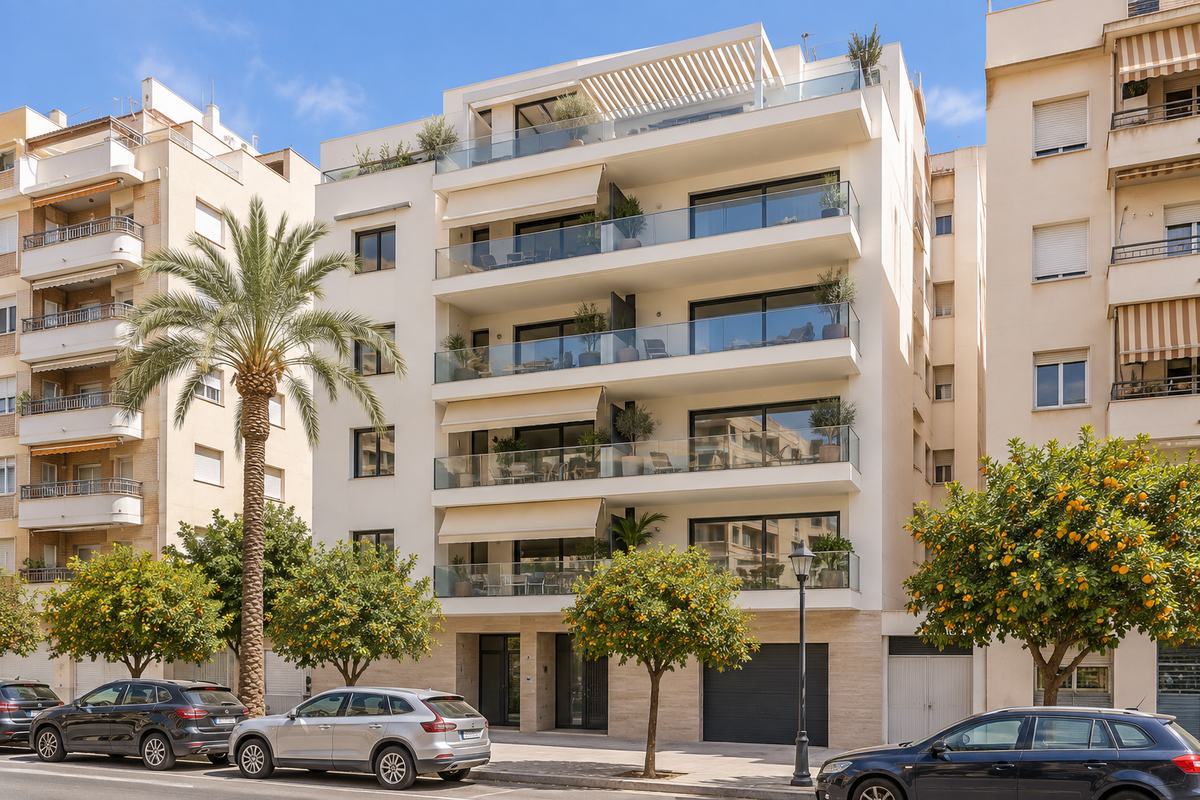 SAMPLE LISTING
This is a sample to show how a listing is laid out. The home, the agent and the agency are invented. The price is in US dollars, the default on RealtyHive listings. Live listings come from the agencies that represent them.
Yes. Spain places no general restriction on foreign nationals buying or owning property, whether or not they live in Spain. The main exception: buyers who are not nationals of an EU country need military authorization in certain restricted zones (the islands, Cartagena, the Strait of Gibraltar, the Bay of Cádiz, Galicia, the land borders, Ceuta and Melilla). In practice this mainly affects rural land; homes in the built-up areas of non-border towns are excluded.
No. Spain stopped granting residence permits for property investment on 3 April 2025. EU, EEA and Swiss citizens may live in Spain; for a stay of more than three months they register within three months of arriving. Other nationals need a residence visa, such as the non-lucrative visa or the visa for remote workers.
On a resale home the largest cost is transfer tax, which each region sets: for example 6% in Madrid, 7% in Andalusia, 9% in the Valencian Community and from 10% in Catalonia. On a new home you pay 10% VAT plus stamp duty. Add notary and registry fees, which follow a regulated scale, and a lawyer if you use one, commonly 1% to 1.5% of the price plus VAT. In the worked example on this page, a €300,000 resale home in Andalusia comes to between 8.5% and 9.6% on top of the price.
It is not a legal requirement. The notary checks identities, the seller’s title, charges on the property and the means of payment, and is impartial between buyer and seller. An independent lawyer, who acts for you and not for the seller or the agent, is optional, and the UK government’s guidance to its own citizens strongly recommends one.
The NIE is the identification number Spain gives to foreign nationals. You need it to sign the deed and pay taxes. You apply at a National Police station in Spain or at a Spanish consulate, in person or through a representative.
Yes. Spanish banks lend to buyers who live abroad, usually up to 60% or 70% of the property’s value, against up to 80% for residents.
The municipal property tax (IBI), and Spain’s non-resident income tax, filed on Modelo 210 each year even if the home is not rented out. The rate is 19% for owners who are tax-resident in the EU or EEA and 24% for others, charged on the rent or, when the home is not rented out, on a deemed income of 1.1% or 2% of its cadastral value. Other taxes can apply, so ask a tax adviser about your case.
The agent who represents that property. Their name and contact details appear first on the listing, and your inquiry goes to them.
No. A bill registered in the Spanish Congress in May 2025 proposes a 100% tax on home purchases by buyers who are not resident in the EU. As of 2 October 2026 it had not been approved.
Ask us. We will reply with what the published sources say and point you to listings in the area you describe. To reach an agent, use the contact button on any listing: it goes to the agent who represents that home.
Your email program should now be open with your question filled in. Send that message and it reaches us. If nothing opened, write to info@realtyhive.com.
Your question is with us and we will reply by email.
RealtyHive listings lead with the agent who represents the home, and your question goes to that agent.